
Internships, Transforming Academic Excellence into Professional Excellence
NEP 2020 and the Future of Higher Education: Building Industry-Ready Graduates Through Structured Internships and Real-World Learning
Bridging the Gap Between Academic Learning and Industry Expectations
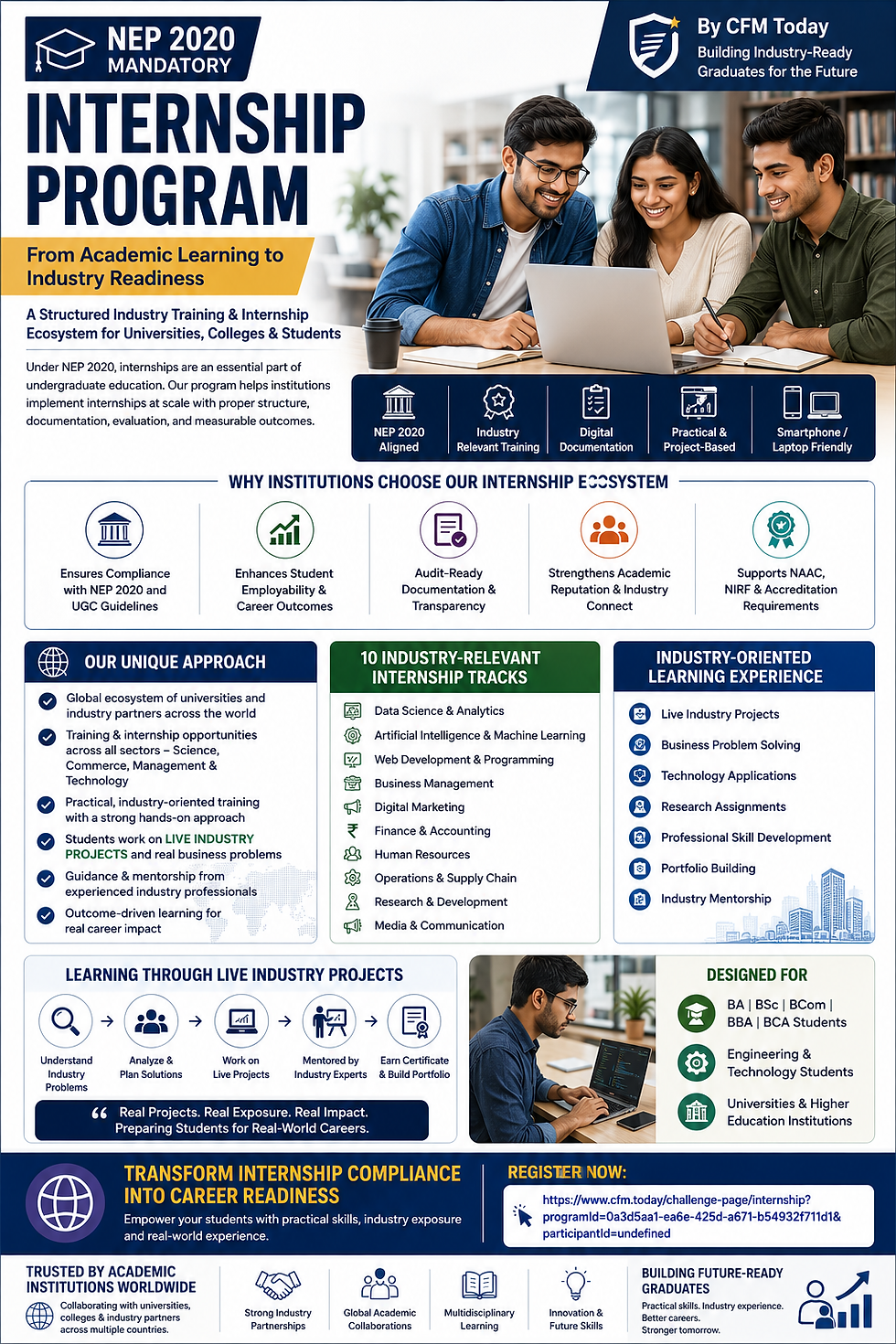
The landscape of higher education is undergoing a fundamental transformation. As industries evolve at an unprecedented pace, employers are increasingly seeking graduates who possess not only academic knowledge but also practical skills, professional confidence, and the ability to solve real-world business challenges.
Recognizing this shift, the National Education Policy (NEP) 2020 has placed significant emphasis on experiential learning, internships, industry engagement, project-based education, and skill development. The objective is clear: create graduates who are prepared to contribute effectively from the very beginning of their professional careers.
While the vision is ambitious, the successful implementation of industry-integrated learning requires strong collaboration between academia and industry. Educational institutions must now move beyond traditional classroom-based teaching models and create opportunities for students to experience real workplace environments, practical assignments, and industry-driven projects.
The Growing Importance of Industry-Academia Collaboration
For decades, one of the most frequently discussed challenges in higher education has been the disconnect between what students learn in classrooms and what organizations expect in the workplace.
Many graduates possess strong theoretical foundations but often lack exposure to:
Practical business applications
Industry workflows
Project execution methodologies
Corporate communication standards
Team collaboration environments
Problem-solving frameworks
Technology-driven work processes
As organizations continue to embrace digital transformation, automation, data analytics, artificial intelligence, and emerging technologies, the demand for job-ready professionals has become more critical than ever.
This has elevated the role of internships from an optional learning experience to an essential component of modern education.
A Globally Connected Internship and Training Ecosystem
Addressing the evolving needs of students and institutions requires more than conventional internship models. It requires a comprehensive ecosystem that brings together universities, industry experts, corporate organizations, mentors, and learning professionals.
Through collaborations with universities, academic institutions, industry leaders, and corporate partners across multiple regions, a unique internship and industry-training ecosystem has emerged that focuses on creating meaningful learning outcomes rather than merely providing certificates.
This ecosystem is designed to support students from diverse academic disciplines, including:
Science
Commerce
Management
Technology
Computer Applications
Business Administration
Emerging Interdisciplinary Programs
The objective is simple: provide students with practical exposure that complements academic learning and prepares them for the realities of the professional world.
Moving Beyond Traditional Internship Models
Traditional internship programs often focus on observation-based learning or theoretical assignments that provide limited exposure to actual industry practices.
Modern employers, however, expect graduates to demonstrate practical capabilities from day one.
To address this expectation, internship programs must be built around:
Real business scenarios
Industry case studies
Live projects
Project-based assignments
Business problem-solving exercises
Research and analytical frameworks
Technology-enabled workflows
Mentorship from experienced professionals
The emphasis is on active participation rather than passive observation.
Students are encouraged to engage with real-world challenges, collaborate on practical assignments, and contribute to project outcomes that reflect actual industry requirements.
Learning Through Live Industry Projects
One of the most effective ways to prepare students for professional careers is through direct exposure to live industry projects.
Live projects provide opportunities for students to:
Understand business challenges
Apply academic concepts in practical situations
Develop analytical thinking
Improve decision-making capabilities
Strengthen communication skills
Build teamwork and collaboration abilities
Gain confidence in professional environments
By working on projects inspired by real organizational requirements, students gain insights that cannot be acquired through classroom instruction alone.
This approach transforms learning from theoretical understanding into practical capability.
Developing Skills That Employers Value
The future workforce requires a blend of technical expertise, business understanding, and professional competencies.
Industry-oriented training programs are increasingly focusing on developing skills such as:
Professional Communication
Effective written and verbal communication remains one of the most sought-after competencies across industries.
Business Analytics and Decision-Making
Organizations rely heavily on data-driven decision-making, making analytical thinking a critical workplace skill.
Digital Transformation Awareness
Students must understand how technology is reshaping business models, operations, and customer experiences.
Project Management
The ability to plan, execute, monitor, and deliver projects is valuable across virtually every industry.
Problem-Solving Capabilities
Employers consistently seek individuals who can identify challenges and develop practical solutions.
Leadership and Collaboration
Modern workplaces require professionals who can contribute effectively within diverse teams while demonstrating leadership potential.
Building Employability Alongside Academic Excellence
Academic achievement remains important, but employability increasingly depends on a candidate’s ability to demonstrate practical experience and workplace readiness.
Students who participate in structured internship and industry-training programs gain opportunities to:
Build professional portfolios
Develop industry-relevant skills
Strengthen resumes
Improve interview readiness
Gain project experience
Expand professional networks
Enhance career confidence
This combination of academic knowledge and practical exposure significantly improves career prospects across sectors.
Supporting Institutional Excellence and Accreditation Goals
For universities and colleges, structured internship programs contribute far beyond student development.
Industry-integrated learning initiatives support institutions by:
Strengthening employability outcomes
Enhancing industry engagement
Supporting outcome-based education models
Improving student satisfaction
Creating measurable learning outcomes
Supporting accreditation and quality assurance objectives
Demonstrating commitment to experiential learning
As regulatory and accreditation frameworks increasingly emphasize student outcomes, institutions that successfully integrate practical learning experiences gain a significant strategic advantage.
Creating Future-Ready Graduates
The ultimate objective of modern higher education is not simply to award degrees but to develop capable, confident, and adaptable professionals.
Future-ready graduates are individuals who possess:
Industry awareness
Practical skills
Professional confidence
Technology proficiency
Critical thinking abilities
Problem-solving capabilities
Real-world project experience
By combining academic excellence with experiential learning, institutions can prepare students to thrive in rapidly evolving professional environments.
Conclusion
The future of higher education lies in creating meaningful connections between academia and industry. As NEP 2020 accelerates the transition toward experiential and outcome-based learning, internships and industry-integrated training programs will play an increasingly important role in shaping student success.
Organizations no longer seek graduates who simply understand concepts. They seek professionals who can apply knowledge, solve problems, collaborate effectively, and contribute from the outset.
Through structured internships, live industry projects, mentorship, and practical learning experiences, educational institutions can bridge the gap between education and employment while empowering students to build successful and sustainable careers.
Explore the Internship Program
Students, universities, colleges, and academic institutions interested in structured industry-oriented internship opportunities can learn more and register at:
The future belongs to graduates who combine academic knowledge with practical capability. Industry-integrated learning is no longer an advantage—it is a necessity.
Comments