
The Future of Marketing Is Being Rewritten by AI: Emerging Career Paths, Business Opportunities, and the Rise of Intelligent Growth

The Future of Marketing Is Being Rewritten by AI: Why Businesses and Professionals Must Adapt Now

Introduction
Artificial Intelligence is no longer a futuristic concept reserved for technology companies. It has become a strategic business capability that is transforming industries, redefining jobs, and changing how organizations attract customers, generate revenue, and create competitive advantages.
Marketing, in particular, is experiencing one of the most significant transformations in its history.
For decades, marketing success depended on creativity, campaign execution, customer communication, and brand positioning. While these fundamentals remain important, AI is introducing a new layer of intelligence, automation, and scalability that is reshaping how modern marketing teams operate.
The question businesses must ask today is no longer:
“Should we adopt AI?”
The real question is:
“How quickly can we transform our organization to leverage AI effectively?”
At CFM Today, we work closely with entrepreneurs, business leaders, startups, consultants, and professionals who are looking to understand emerging trends and position themselves for long-term growth. One trend is becoming increasingly clear:
The future belongs to professionals and organizations that combine human intelligence with artificial intelligence.
The Great Marketing Transformation
Historically, marketing departments were structured around specialized functions:
Content Creation
Social Media Management
Email Marketing
SEO
Paid Advertising
Lead Generation
Analytics
Brand Management
Artificial Intelligence is now connecting all these functions together through intelligent workflows and automation systems.
Tasks that once required multiple employees can now be executed through integrated systems powered by AI, machine learning, workflow automation, and predictive analytics.
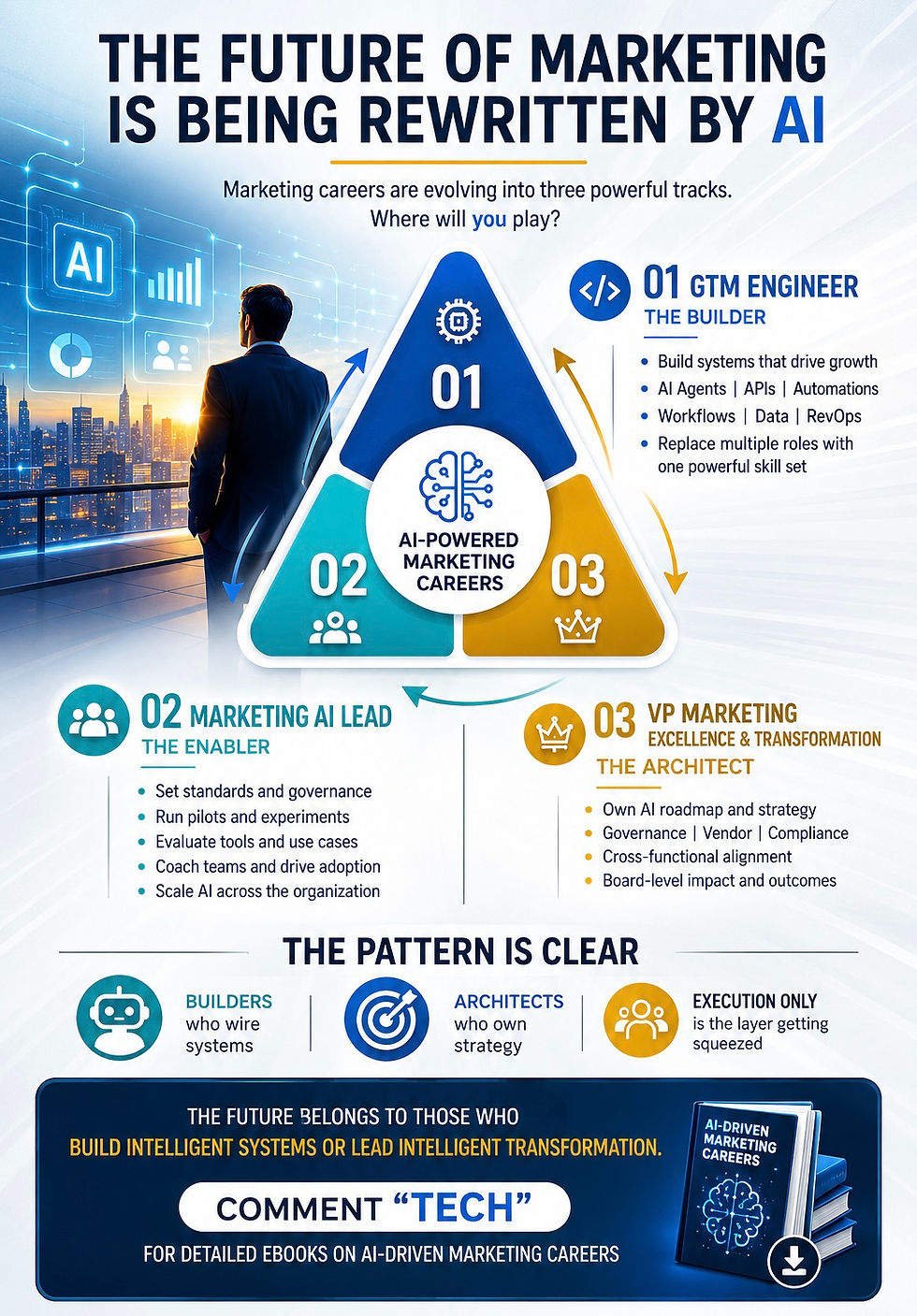
As a result, marketing is evolving into three distinct strategic career paths.
Career Path 1: GTM Engineer – The Builder
Who Is a GTM Engineer?
A GTM (Go-To-Market) Engineer is a professional who combines marketing knowledge with technical capabilities to design and automate business growth systems.
Instead of manually running campaigns, GTM Engineers build the infrastructure that powers campaigns.
They focus on:
AI Agents
Marketing Automation
CRM Integrations
API Connectivity
Lead Routing Systems
Revenue Operations
Data Intelligence
Customer Journey Automation
These professionals act as architects of business growth engines.

Why GTM Engineers Are Becoming Essential
Modern businesses generate enormous amounts of data.
Without automation:
Leads get missed.
Follow-ups become inconsistent.
Customer experiences become fragmented.
Revenue opportunities are lost.
A GTM Engineer creates systems that eliminate these inefficiencies.
For example:
A potential customer visits a website.
Instead of requiring manual intervention:
AI identifies the visitor.
Marketing automation sends personalized communication.
CRM records the interaction.
Sales teams receive qualified opportunities.
Performance dashboards update automatically.
This entire workflow can happen within seconds.
Skills Required for Future GTM Engineers
Professionals entering this field should focus on:
AI Tools
ChatGPT
Claude
Gemini
Perplexity
Automation Platforms
n8n
Zapier
CRM Platforms
Salesforce
HubSpot
Zoho CRM
Technical Skills
APIs
Data Management
Workflow Design
Automation Logic
Business Skills
Revenue Operations
Customer Experience
Funnel Optimization
Conversion Analytics

Career Path 2: Marketing AI Lead – The Enabler
Why Every Organization Needs AI Leadership
Many companies are experimenting with AI.
Very few are implementing AI successfully at scale.
This is where the Marketing AI Lead becomes critical.
Their role is not to build every solution.
Their role is to ensure the organization adopts AI effectively.
They bridge the gap between technology and business outcomes.
Responsibilities of a Marketing AI Lead
A Marketing AI Lead typically:
Defines AI Strategy
Creates a roadmap for AI adoption.
Evaluates AI Solutions
Assesses which tools align with business objectives.
Establishes Governance
Creates policies and frameworks for responsible AI usage.
Trains Teams
Ensures employees understand how to leverage AI effectively.
Measures Results
Tracks productivity improvements and business impact.
The Growing Need for AI Governance
As AI adoption increases, organizations face new challenges:
Data Privacy
Security Risks
Compliance Requirements
Ethical AI Usage
Intellectual Property Protection
Companies require professionals who can create responsible AI frameworks while driving innovation.
This makes the Marketing AI Lead one of the most valuable emerging leadership roles.

Career Path 3: VP Marketing Excellence & Transformation – The Architect
The Strategic Leadership Layer
At the executive level, AI becomes a business transformation initiative rather than a marketing tool.
Senior leaders must answer critical questions:
Where should AI be deployed?
Which business processes should be automated?
What risks exist?
Which vendors should be selected?
How should AI investments be measured?
This responsibility belongs to transformational leaders.
Key Responsibilities
AI Roadmap Development
Creating long-term AI strategies.
Organizational Transformation
Aligning departments around common objectives.
Vendor Selection
Choosing technology partners.
Risk Management
Maintaining compliance and governance.
Executive Communication
Helping boards and stakeholders understand AI investments.
Innovation Leadership
Identifying future growth opportunities.

The Rise of AI-Powered Business Models
AI is not merely changing jobs.
It is creating entirely new business models.
Businesses can now:
Deliver personalized customer experiences.
Automate service delivery.
Scale globally with smaller teams.
Improve operational efficiency.
Reduce costs.
Increase profitability.
Organizations that embrace AI gain a significant competitive advantage.
AI Technologies Transforming Modern Marketing
AI Content Generation
Businesses can accelerate:
Blog Creation
Social Media Content
Email Campaigns
Ad Copy
Product Descriptions
while maintaining quality and consistency.
Predictive Analytics
AI can identify:
Future customer behavior
Purchase likelihood
Churn risk
Sales opportunities
before humans recognize patterns.
Conversational AI
Modern AI assistants can:
Answer customer queries
Qualify leads
Schedule appointments
Provide support
24/7.
Hyper-Personalization
AI enables businesses to deliver customized experiences based on:
Customer interests
Behavioral data
Purchase history
Engagement patterns
creating stronger customer relationships.
Why Businesses Cannot Ignore AI Anymore
Organizations that delay AI adoption face several risks:
Reduced Competitiveness
Competitors become faster and more efficient.
Higher Operational Costs
Manual processes become expensive.
Slower Decision Making
AI-powered insights accelerate strategic decisions.
Talent Challenges
Top professionals increasingly prefer innovative organizations.
The market is rewarding companies that embrace transformation.
How CFM Today Supports Businesses in the AI Era
At CFM Today, we believe that technology should empower growth rather than create complexity.
We help businesses understand and navigate modern transformation initiatives through:
Business Advisory
Strategic guidance for future-ready organizations.
Corporate Consulting
Building scalable business frameworks.
Technology Integration Planning
Identifying opportunities for automation and efficiency.
Startup Support
Helping entrepreneurs build modern, growth-oriented businesses.
Professional Development
Supporting professionals in acquiring future-relevant skills.
Our mission is to help organizations remain competitive in a rapidly evolving business environment.
The Skills That Will Define Future Success
Regardless of industry, professionals should focus on developing:
✔ Strategic Thinking
✔ AI Literacy
✔ Data Interpretation
✔ Automation Knowledge
✔ Problem Solving
✔ Leadership Skills
✔ Business Communication
✔ Technology Adaptability
The future workforce will not be divided between technical and non-technical professionals.
It will be divided between those who understand how to work alongside AI and those who do not.
Final Thoughts
Artificial Intelligence is not replacing human potential.
It is amplifying it.
The most successful professionals and businesses will be those that learn how to combine creativity, leadership, strategic thinking, and technology.
Marketing is becoming a discipline powered by systems, intelligence, and transformation.
The builders will create the systems.
The enablers will drive adoption.
The architects will shape the future.
The opportunity is enormous for those willing to embrace change.
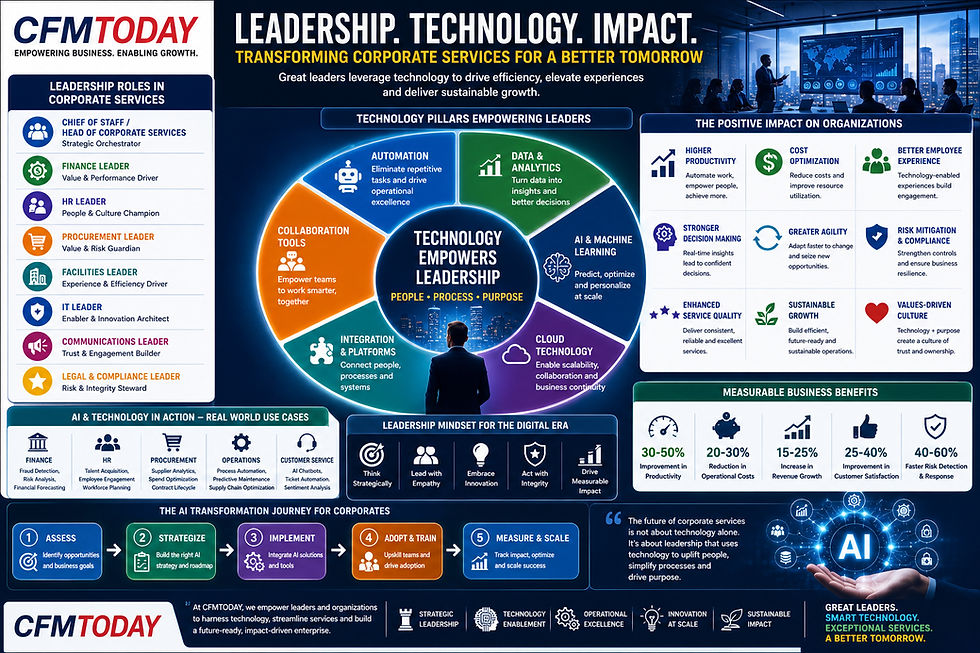
The future of marketing is not coming.
It has already arrived.
And the organizations that act today will become the leaders of tomorrow.
About CFM Today
CFM Today is committed to helping businesses, entrepreneurs, startups, and professionals navigate the changing world of business, technology, corporate strategy, compliance, and growth. Through expert insights and practical guidance, CFM Today empowers organizations to build sustainable success in an increasingly digital and AI-driven economy.


Comments