
Why AI Search Is Reshaping Digital Marketing and Customer Decision-Making

The Evolution of SEO: Why AI Search Is Reshaping Digital Marketing and Customer Decision-Making
From AIDA to AI: How Businesses Can Build Trust, Authority, and Visibility in the New Search Economy
By CS Bhaskar Kushwaha
Company Secretary | Corporate Strategist | Startup & AI Business Consultant
Introduction
For more than a century, businesses have relied on a simple marketing framework to understand customer behaviour. Whether selling a product, promoting a service, or building a global brand, the objective has always been the same: attract attention, generate interest, create desire, and encourage action.
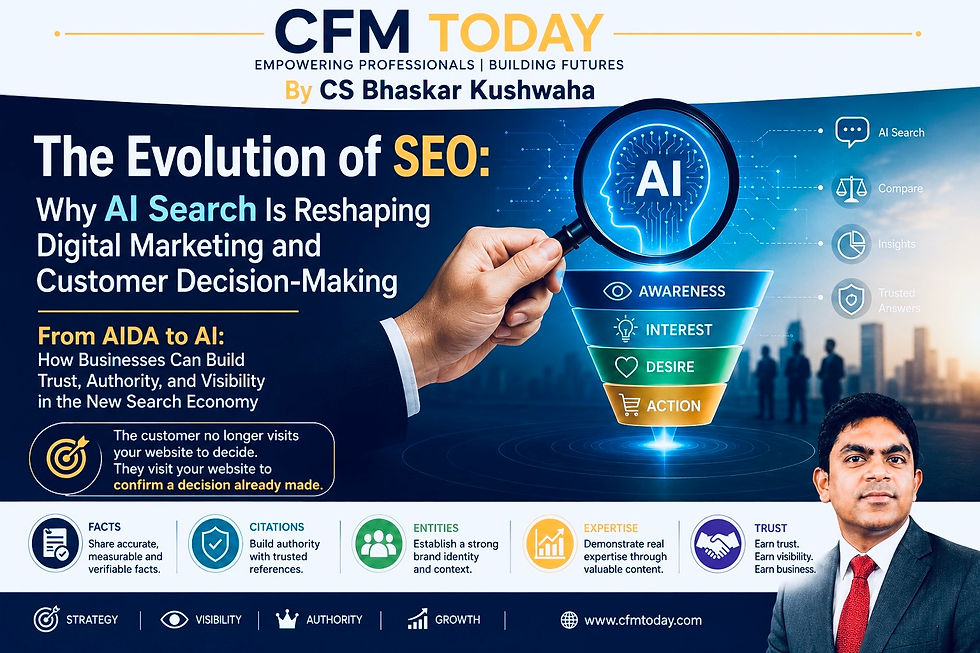
This framework, known as the AIDA Model, has guided advertising and marketing professionals since the late nineteenth century. It influenced newspapers, radio, television, websites, search engines, and social media.
Today, however, the digital ecosystem is undergoing its most significant transformation since the birth of the internet.
Artificial Intelligence has changed how people search, compare, evaluate, and ultimately make purchasing decisions. Customers are no longer dependent solely on search engines or company websites. Instead, they ask AI assistants to summarize information, compare alternatives, explain complex topics, and recommend solutions.
This shift is not replacing Search Engine Optimization (SEO); rather, it is expanding it into a broader discipline where trust, authority, structured information, and educational content play an increasingly important role.
The organizations that understand this evolution early will not only improve their online visibility but also strengthen customer confidence and long-term brand value.
This article explains how the traditional AIDA model is evolving, why AI search is transforming customer behaviour, and what practical steps businesses, educators, professionals, and students should take to remain competitive in the emerging AI-powered digital economy.
Chapter 1: Understanding the Foundation of Modern Marketing – The AIDA Model
Marketing has always been about influencing human behaviour.
Long before websites, smartphones, and artificial intelligence existed, businesses needed a systematic way to understand how customers made buying decisions.
In 1898, American advertising pioneer Elias St. Elmo Lewis introduced one of the most influential marketing frameworks ever created—the AIDA Model.
AIDA represents four sequential stages:
A – Awareness: The customer first becomes aware of a product, service, or brand.
I – Interest: The customer begins learning more and develops curiosity.
D – Desire: Interest develops into preference and emotional motivation.
A – Action: The customer purchases, subscribes, registers, or takes another desired action.
For decades, nearly every marketing campaign was designed around these four stages.
A newspaper advertisement generated awareness.
A brochure or website created interest.
Testimonials, product demonstrations, and case studies generated desire.
Finally, a sales representative or checkout page encouraged action.
The company controlled nearly every step of the customer journey.
Chapter 2: The Traditional Customer Journey
The conventional digital marketing funnel followed a predictable path:
Advertisement → Search Engine → Website → Product Information → Reviews → Comparison → Purchase
The business website served as the centre of the decision-making process.
Customers visited multiple pages, explored features, compared pricing, downloaded brochures, read blogs, and contacted sales teams before making a purchase.
SEO was primarily focused on driving visitors to the website, where businesses had complete control over messaging and persuasion.
Traffic volume became the dominant success metric.
Chapter 3: Why Customer Behaviour Has Changed
Artificial Intelligence has fundamentally altered this process.
Today, customers often seek answers before visiting a website.
Instead of searching with keywords such as:
“Best accounting software”
they ask conversational questions like:
Which accounting software is best for a manufacturing company?
Compare the top five accounting platforms for SMEs.
Which solution offers better compliance support?
What are the disadvantages of each option?
Instead of browsing ten websites, customers receive synthesized explanations from AI systems, allowing them to understand the market more efficiently.
This means the stages of Interest and Desire increasingly develop before the customer reaches a company’s website.
By the time visitors arrive, they are often well informed and closer to making a decision.
Chapter 4: The Evolution from Search to AI-Assisted Decisions
Traditional search engines were designed to retrieve information.
AI systems are designed to help people understand information.
Search engines typically provide a list of links.
AI platforms aim to organize, summarize, and compare information from multiple sources to answer a user’s question more directly.
As a result, the role of a business website is changing.
Instead of serving as the customer’s primary research destination, it increasingly becomes the place where customers validate their decision, explore specific details, and complete a transaction.
Chapter 5: Why SEO Is Evolving Rather Than Disappearing
A common misconception is that Artificial Intelligence will replace SEO.
This is inaccurate.
SEO remains essential because websites continue to provide the content, documentation, and expertise that AI systems and search engines rely upon.
What has changed is the definition of optimization.
Businesses must now optimize not only for search engines but also for human understanding and AI interpretation.
This broader approach is often referred to as Generative Engine Optimization (GEO).
Rather than focusing exclusively on rankings, GEO emphasizes creating content that is factual, well-structured, authoritative, and genuinely useful.
Chapter 6: The New Customer Journey
The emerging decision-making process often looks like this:
Awareness↓AI Research↓Fact Verification↓Brand Comparison↓Expert Validation↓Website Visit↓Action
This journey highlights an important change:
Customers increasingly arrive with questions already answered and expectations already formed.
The website becomes the final confirmation rather than the beginning of the conversation.
Chapter 7: The Five Pillars of AI-Era Visibility
The future of digital visibility depends on five interconnected pillars:
1. Accurate Facts
Support every claim with measurable information.
2. Credible Evidence
Publish case studies, reports, certifications, research, and documented outcomes.
3. Independent Validation
Encourage recognition through industry publications, professional associations, conferences, and third-party references.
4. Consistent Digital Identity
Maintain a consistent organization name, leadership profile, and service descriptions across every platform.
5. Educational Content
Create resources that answer genuine customer questions rather than simply promoting products.
Chapter 8: Practical Strategies for Businesses
To thrive in the AI-powered search economy:
Develop comprehensive educational blogs.
Publish FAQs that address customer concerns.
Produce original research and white papers.
Build a recognizable executive brand.
Share measurable business achievements.
Maintain consistent information across digital channels.
Update content regularly to reflect current developments.
Focus on solving problems before promoting services.
Chapter 9: What This Means for Students, Educators, and Professionals
This transformation is not limited to businesses.
Students must learn how AI-assisted search changes research methods.
Educators should teach learners to evaluate sources critically and understand how AI synthesizes information rather than accepting every output at face value.
Professionals should build their personal brand through thoughtful articles, presentations, and practical insights.
The future workforce will be distinguished by its ability to create trustworthy knowledge, communicate clearly, and adapt to evolving technologies.
Conclusion
The evolution of SEO is not the end of digital marketing; it is the beginning of a more intelligent, transparent, and knowledge-driven era.
Businesses that focus solely on attracting clicks may struggle to build lasting relationships.
Organizations that invest in expertise, structured knowledge, consistent branding, and customer education will earn something far more valuable than rankings: trust.
As AI continues to reshape how people discover and evaluate information, the most successful organizations will be those that become recognized sources of reliable knowledge.
The future belongs not to those who publish the most content, but to those who publish the most useful, accurate, and credible content.
Final Thought
“The future of SEO is no longer about being found first. It is about becoming the most trusted answer when people—and AI—seek reliable knowledge. Visibility attracts attention, but authority earns trust, and trust drives lasting business success.”


Comments